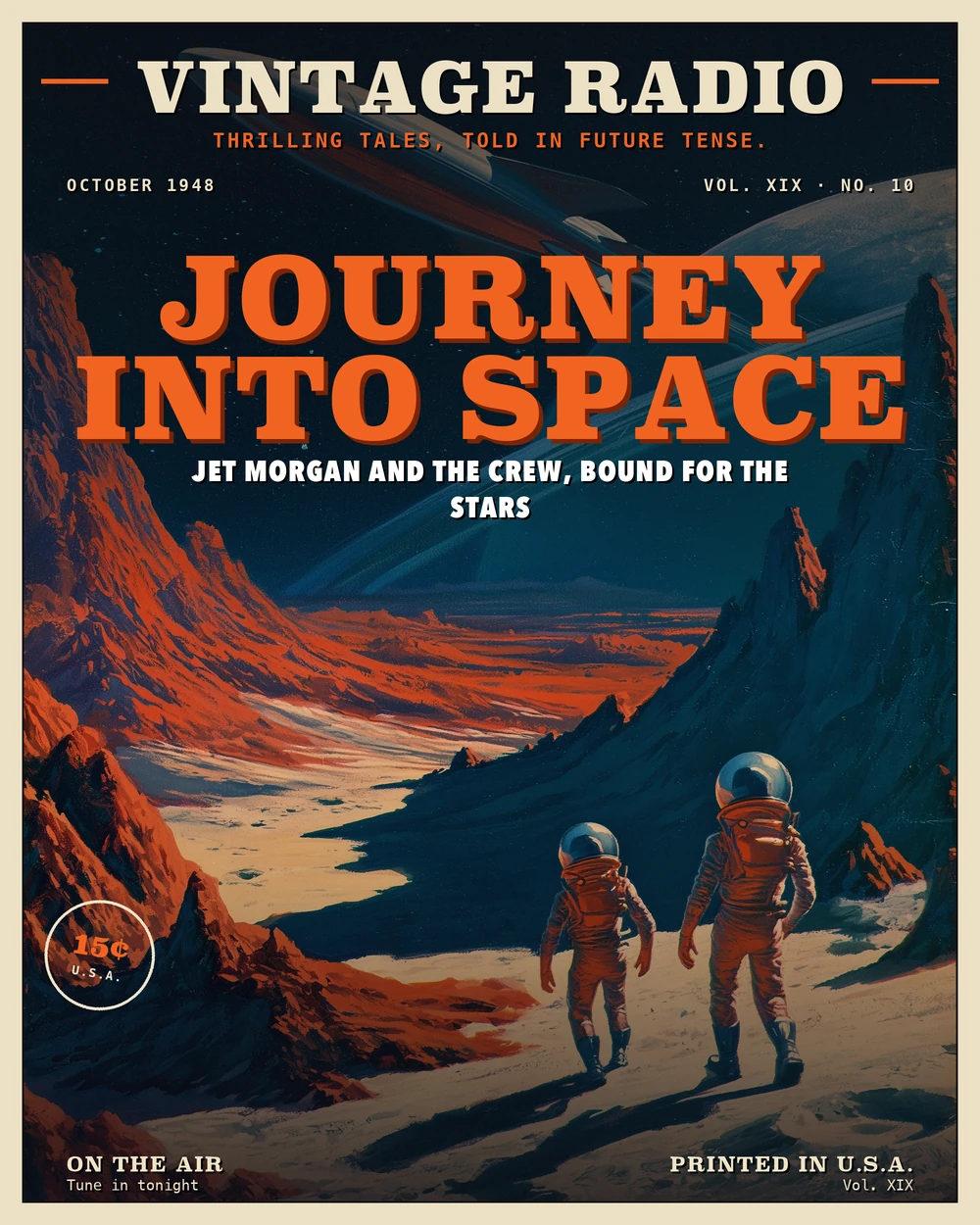
Journey Into Space
The Last Radio Programme to Beat Television
On the evening of January 10, 1955, something happened that would never happen again in British broadcasting. Episode 19 of The Red Planet — the second series of Journey Into Space — pulled a 17% audience share on the BBC Light Programme, while the simultaneous BBC television newsreel managed only 16%. It was the last time a UK radio programme attracted a bigger evening audience than television. That single statistic captures what the show meant to British listeners in the mid-1950s. This was not a nostalgia item even then. It was the most-listened-to thing in the country on a Monday night.
The series ran from October 19, 1953, to February 6, 1956, across three story arcs: Operation Luna (the first series, originally titled Journey to the Moon), The Red Planet, and The World in Peril. All three were written and produced for the BBC Light Programme by Charles Chilton, and together they add up to 51 surviving episodes of science fiction radio unlike much else broadcast on either side of the Atlantic.
How Charles Chilton Got Here
Charles Chilton was born on June 15, 1917, and joined the BBC as a teenager, starting in the record library and working his way up over the years to full producer. He had made his name with the long-running Western serial Riders of the Range when Michael Standing, then Head of the BBC Variety Department, asked him to try something different: a science fiction programme. Chilton agreed, and the result was Journey to the Moon, the serial that would eventually be re-released as Operation Luna.
Chilton set the series in 1965, the year he believed humans would first walk on the Moon — a guess that was only four years off. He sought out technical advice from Flight Lieutenant Roger Burton and Kenneth Gatland of the British Interplanetary Society, which gave the scripts a grounding listeners noticed, even if some scientific inaccuracies still drew audience letters. The Science Fiction Encyclopedia later credited Chilton's "dialogue skills and background in amateur astronomy" with bringing "a gripping authenticity to these radio serials." Chilton was not a genre writer slumming in space — he was genuinely interested in where humanity might actually go.
The premiere of Journey to the Moon drew 5.1 million listeners, a solid start. But the early, Earth-set episodes proved slow going for audiences, and numbers dipped. Once the rocket launched in episode 5, the show found its footing. By the final episode of that first series, the audience had grown to 8 million.
The Crew of the Ship
The four regular characters anchored all three series. Captain Andrew "Jet" Morgan was played by Andrew Faulds — who later became a Labour Member of Parliament. Ship's doctor Daniel "Doc" Matthews was played by Guy Kingsley Poynter. Australian engineer Stephen "Mitch" Mitchell and Cockney radio operator Lemuel "Lemmy" Barnett rounded out the crew, providing both practical expertise and, in Lemmy's case, a good deal of the show's warmth and comic texture.
The casting shifted as the series progressed. In The Red Planet, Mitch was played by Bruce Beeby and Lemmy by David Kossoff; by The World in Peril, Don Sharp had taken over as Mitch and Alfie Bass as Lemmy. These weren't replacements in the Hollywood sense — the characters themselves remained consistent, and the transitions were handled matter-of-factly. What stayed constant across all three series was the dynamic of the four-man crew navigating situations that tested exploration, survival, and human resilience in roughly equal measure.
The Way It Sounded
The most iconic sound effect in the entire run — the dramatic rocket take-off that opened each episode — was not constructed in a studio. It was a recording of an actual jet aircraft at Heathrow airport. Other sound effects were created at Battersea Power Station. Chilton was working at the BBC during a period when the organization was experimenting seriously with what radio could do technically, and the show reflected that.
The music for all three series was composed and conducted by Van Phillips, and a distinctive feature of the score was the use of the clavioline — an early electronic keyboard instrument — which gave the incidental music an otherworldly texture that set it apart from conventional radio drama of the period. The combination of real-world industrial recording and electronic music gave Journey Into Space an audio landscape that was genuinely different from what listeners encountered elsewhere on the dial.
Three Series, Three Missions
Operation Luna — the first series, initially titled Journey to the Moon — sent the crew on a lunar mission set in a then-near-future 1965. The original master tapes of this first series were erased in accordance with BBC policy at the time: tapes were wiped three months after broadcast. The series was re-recorded and re-broadcast in 1958 under the title Operation Luna, though the first four episodes were omitted in that re-recording.
The Red Planet followed, running for 20 episodes on the BBC Light Programme from September 6, 1954, to January 17, 1955. This was the series that sent the crew to Mars — and the one that beat television in the ratings at its peak. The themes of exploration and survival ran through the storyline with enough urgency to hold 8 million listeners through a British winter.
The World in Peril completed the trilogy, broadcasting from September 26, 1955, to February 6, 1956. Together, the three arcs constituted a coherent, escalating saga — from the Moon outward, with the stakes growing with each series.
After the Broadcast
The story of what happened to Journey Into Space after 1956 has two chapters. The first is a near-loss. The original tapes of Journey to the Moon were wiped, as noted — gone under the BBC's standard policy of the era. For decades, a complete set of all three original series seemed unlikely to exist anywhere. Then, in 1986, a set of misfiled BBC Transcription Service discs turned up, containing complete copies of all three original series. That discovery allowed the BBC to begin re-broadcasting the show in the late 1980s and eventually release it on cassette, CD, and digital download.
The second chapter involves reach. While the show was still on the air, it was translated into 17 languages — including Hindi, Turkish, and Dutch — and broadcast in Australia, the Netherlands, New Zealand, and the United States. Chilton also wrote three novels based on the radio scripts: Journey Into Space (Herbert Jenkins, 1954), The Red Planet (1956), and The World in Peril (1960), all of which sold well. In 1956, the Junior Express comic began publishing Journey Into Space comic strips, with scripts by Chilton and artwork by Italian artist Ferdinando Tacconi; the opening strip, Jet Morgan in Planet of Fear, was a 35-episode sequel to The World in Peril.
A revival came on March 7, 1981, when Chilton wrote The Return from Mars, a 90-minute episode for BBC Radio 4's Saturday Night Theatre slot, picking up the story from where The World in Peril had left off. Chilton himself remained connected to the BBC in other capacities — he was a producer on The Goon Show and later inspired the stage musical and film Oh, What a Lovely War! He received an MBE and lived until January 2, 2013.
Notable fans of the series, documented over the years, included Stephen Hawking, former Prime Minister John Major, comedian Kenny Everett, planetary scientist Colin Pillinger, actress Miriam Margolyes, and former Doctor Who producer Philip Hinchcliffe. What that list suggests, if nothing else, is that the show reached across a wide range of people and held on.